8. Schedulers, stalls, and execution pipes
Each SM has warp schedulers. On a cycle, a scheduler chooses an eligible warp and issues its next instruction. A warp is 32 threads executing the same instruction together in lockstep (SIMT); "issuing an instruction" for a warp means all 32 lanes step forward together. A warp may be active but ineligible because an operand, pipeline, barrier, or memory dependency is not ready — it is "not eligible" precisely when the next instruction it needs to run still has an unmet dependency: an operand not yet computed, a memory value not yet returned, a barrier not yet reached.
Start with scheduler health
| Metric | Question |
|---|---|
| active warps/scheduler | how much latency-hiding inventory exists? |
| eligible warps/scheduler | how many can issue now? |
| issued warps/scheduler | how often does useful issue occur? |
| no eligible (%) | how often is the scheduler starved? |
| issue slots busy | is instruction issue itself well utilized? |
Only after establishing poor issue efficiency should stall reasons dominate the investigation.
Common stall reasons
Names vary slightly by architecture and tool release; use the installed Profiling Guide for exact definitions.
| Stall | Usually means | Productive experiments |
|---|---|---|
| Long Scoreboard | wait for L1TEX-tracked memory result, often global/local | coalescing, cache reuse, prefetch, more independent work/warps |
| Short Scoreboard | shorter MIO/shared-memory dependency | shared layout, bank conflicts, scheduling |
| Math Pipe Throttle | target arithmetic pipe is saturated | reduce operations, use faster precision/pipe, improve tiling |
| MIO Throttle | LSU/SFU/shared/branch issue pressure | simplify addressing, redistribute instruction mix |
| Barrier | CTA/warp synchronization imbalance | reduce barriers, balance producer/consumer work |
| Wait | fixed-latency dependency or explicit wait | add independent instructions, pipeline stages |
| Sleeping | nanosleep or deliberate producer/consumer backoff | often normal in persistent/warp-specialized kernels |
| Not Selected | another eligible warp issued | generally healthy if issue slots are busy |
| Branch Resolving / Divergence | control-flow dependency or lane disagreement | predication, regroup work, uniform branches |
Turning a stall diagnosis into a fix
The table above names a direction — "coalescing," "reduce operations," "predication" — but a direction is not yet a technique. This section fills in the concrete mechanism behind each stall category's productive experiments, so a diagnosis has somewhere specific to go.
Long Scoreboard and MIO Throttle (memory-bound stalls). If a warp is
repeatedly stalling because its next instruction needs a value that has not
come back from memory yet, the instruction stream is asking for data too
late relative to when it is used. Software pipelining, also called
double buffering, restructures the loop so the load for tile is
issued before the compute on tile finishes, using a second buffer (a
second shared-memory tile or register set) so the two tiles do not collide.
The warp then has independent work — compute on the already-resident tile —
to issue while the new load is in flight, instead of stalling on every load
it makes. Vectorized loads attack the same stall from the instruction
side: replacing four scalar float loads with one float4 (or the int4
equivalent) load moves the same bytes in a quarter of the instructions,
which reduces address-generation and issue-slot pressure on the memory pipe
and, when the access is already contiguous per thread, tends to raise sector
efficiency as a side effect (see ch. 9's coalescing discussion for the sector
mechanics). On Ampere and newer, cp.async gives a warp a way to issue an
asynchronous global-to-shared copy that never round-trips through the
register file, freeing registers and letting the copy proceed while the warp
does other work; on Hopper and newer, the Tensor Memory Accelerator (TMA)
extends the same idea to bulk, whole-tile copies issued by a single thread on
behalf of the CTA. These two mechanisms are the hardware underneath the
"producer warps issue copies, consumer warps issue MMA" pattern described
from the resource-budget side in ch. 10's warp-specialization section; this
section is the same pattern described from the instruction-sequencing side —
overlap is what turns a per-tile load stall into hidden latency.
Short Scoreboard and Barrier (on-chip dependency stalls). When the
dependency is between lanes of the same warp — a reduction, a small
exchange, a broadcast — routing the value through shared memory and a
__syncthreads() barrier is often more machinery than the problem needs.
Warp-level shuffle intrinsics (__shfl_sync and its variants) let the 32
lanes of one warp exchange register values directly, with no shared-memory
write, no barrier, and no bank-conflict exposure, because the exchange
happens inside the warp's own execution unit rather than through the shared
memory system. This only applies within a single warp — cross-warp exchange
still needs shared memory (and, if it must be ordered, a barrier), so
shuffles are a targeted fix for warp-local dependency stalls, not a general
replacement for shared-memory communication.
Math Pipe Throttle. Once a kernel's instruction stream is already minimal for the algorithm, "reduce operations" stops being available as a lever, and only two real levers remain. One is raising arithmetic intensity — doing more MACs per byte already resident, through tiling and reuse — which is the same roofline argument ch. 9 makes from the bandwidth side; the two are connected because a kernel that is compute-throttled on a low-precision pipe while its data is barely reused is often better addressed by fixing reuse than by chasing the compute pipe directly. The other is moving the work to a cheaper or lower-precision pipe: routing matrix-shaped math through a Tensor Core TF32/FP16/BF16/FP8 path instead of scalar FP32 CUDA-core instructions, where the workload's correctness budget tolerates the reduced precision. Neither lever is "delete instructions" — that option is rarely on the table once the algorithm itself is fixed.
Branch Resolving / Divergence. Divergence stalls come from lanes in a
warp disagreeing about which path to take, forcing the hardware to execute
both paths serially with lanes masked off. Two techniques address this at
different levels. Grouping or sorting data so that the lanes assigned to
one warp are likely to agree on the branch outcome — for example, sorting
work items by the predicate before launch, or assigning a warp's lanes
contiguous rather than interleaved elements — removes the disagreement at
the data level, before the kernel ever runs. Predication removes it at
the instruction level: rewriting a short conditional as arithmetic (min,
max, a select, or a ternary) so every lane computes both outcomes and
selects, rather than branching. Predication trades wasted arithmetic for
guaranteed uniform control flow, so it pays off exactly when the conditional
body is cheap enough that computing both sides costs less than the
divergence did.
Sleeping (persistent and warp-specialized kernels). Sleeping stalls are not automatically a defect — ch. 10's warp-specialized GEMM is a case where they are the expected behavior of producer warps waiting for the next hand-off. The mechanism that produces this pattern deliberately is the persistent-kernel pattern: instead of launching a grid sized to cover the problem in one shot, the grid is sized to exactly the number of CTAs the device can keep resident, and each CTA loops internally over the problem's tiles — pulling work from a queue or a fixed schedule — until the problem is exhausted. Because the CTAs never exit and relaunch, a warp within one can go idle (sleeping) between hand-offs without paying a relaunch cost, which is what makes low occupancy and high sleeping time compatible with a near-saturated target pipe rather than being evidence of starvation.
Read stalls as a causal chain
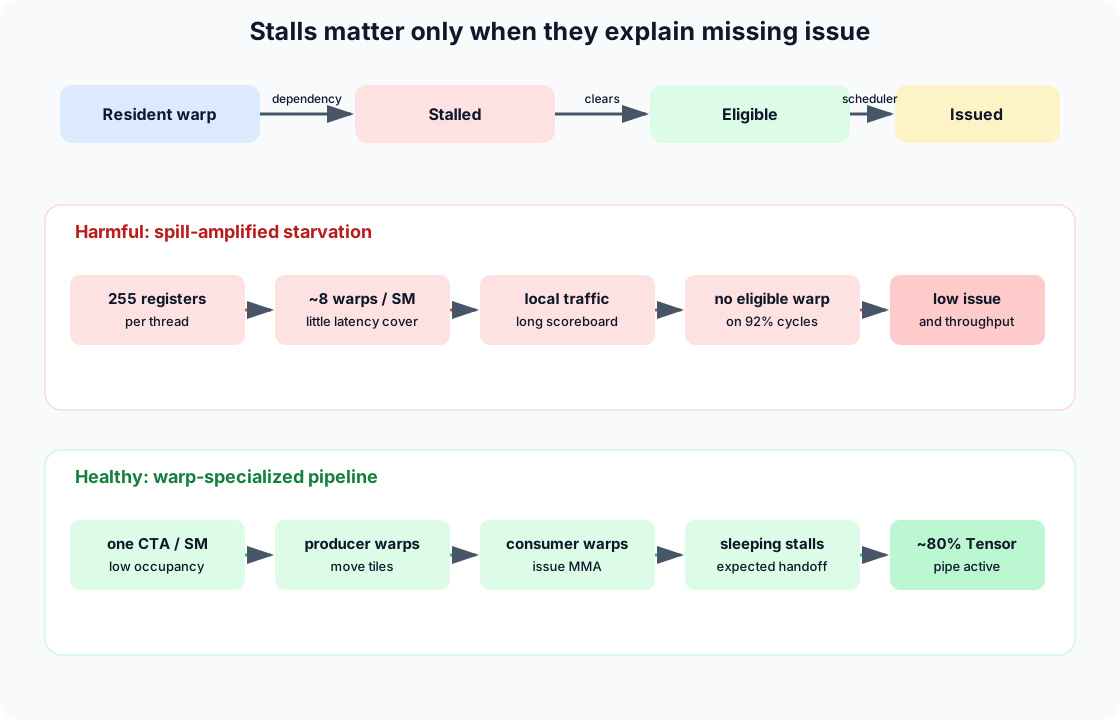
A stall table only becomes a diagnosis once it is chained to occupancy and to the pipe the kernel is supposed to be feeding. Two kernels can report nearly the same low occupancy and mean opposite things:
| Kernel | Occupancy | Dominant stall | Target pipe | Diagnosis |
|---|---|---|---|---|
| Backward kernel with register spills (ch. 7) | 16.6% achieved, matching theoretical | Long Scoreboard, with ~92% of scheduler cycles finding no eligible warp | starved, not fed | causal defect: spills create the long-scoreboard traffic, and too few resident warps exist to hide it |
| Warp-specialized GEMM (ch. 10) | 17–25% achieved, by design | Sleeping, from deliberate producer/consumer backoff | Tensor pipe at 75–85% utilization | healthy: occupancy is intentionally low, and the pipe it feeds is nearly saturated |
Same headline number, opposite root cause: one kernel is starved because eligible warps are scarce and the ones present are waiting on memory; the other is idle by design because deep pipelining needs fewer, heavier CTAs. The same “low occupancy” headline supports opposite conclusions once scheduler and pipeline evidence is included.
Pipeline misalignment
SM utilization is an umbrella; inspect its breakdown. A kernel can issue many integer address instructions while barely using FP/Tensor units, or saturate Tensor units while overall SM percentage appears moderate.
| Dominant pipe | Typical workload | Possible mismatch |
|---|---|---|
| Tensor | dense/block-scaled MMA | poor tile waves, unsupported dtype/layout |
| FP32/FP64 | scalar/vector arithmetic | unintended promotion or non-Tensor GEMM |
| LSU | gather/scatter, copies, quantization | excessive address/memory instructions |
| SFU | transcendental functions | expensive exact math where approximation is valid |
| uniform/branch | control-heavy kernels | divergent work assignment |
Inspect executed instruction counts and source-correlated hot instructions before rewriting code around a single utilization percentage.