12. Controlled performance experiments
A counter report should end in an experiment, not an adjective.
Write the hypothesis first
Use this form:
Because evidence, changing one mechanism should improve specific counters and reduce specific elapsed time, without changing correctness constraints.
Example:
Because a backward kernel is register-limited to eight active warps/SM and local-memory loads dominate its long-scoreboard samples, shortening the live range of the per-thread accumulator should reduce local sectors and no-eligible cycles, then reduce both kernel and iteration time.
Keep an experiment ledger
Turn each hypothesis into a row before running it, and keep every prior row instead of overwriting it — the ledger is what lets a later result be compared against the reasoning that motivated it:
| Revision | Workload | Change | Median | p20–p80 | Key counters | Correct? |
|---|---|---|---|---|---|---|
| baseline | M,N,K / batch,seq | none | … | … | … | yes |
| A | same | smaller tile | … | … | regs, spills, Tensor% | yes/no |
Do not combine tile size, precision, fusion, and launch geometry in one patch if you want to understand causality. Change several of them at once and a favorable result cannot be attributed to any one of them — an improvement without a known mechanism is a lucky patch, not the kind of causal, generalizable understanding of the kernel that lets you predict its behavior on the next shape or the next change.
A favorable median in the ledger is not yet a validated result — it still has to survive the same causal chain the hypothesis predicted, link by link.
Optimization proof chain
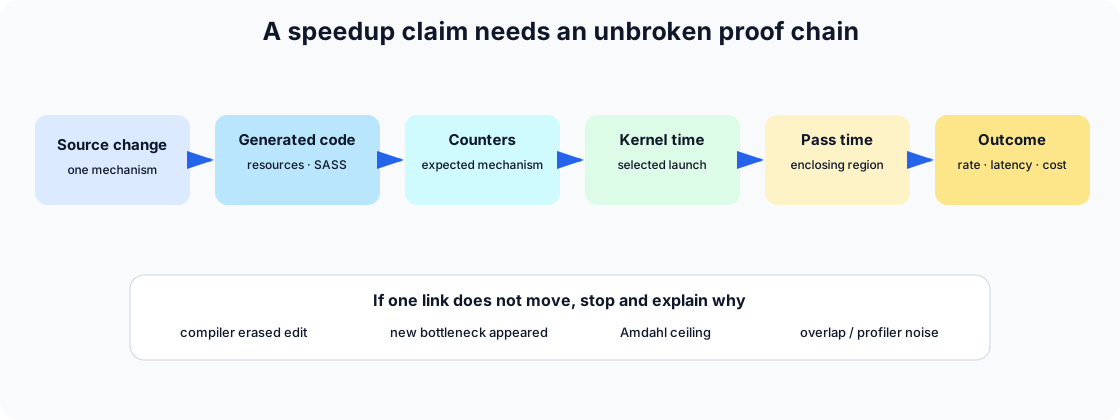
If the chain breaks:
- generated code unchanged: the compiler optimized away or restructured the edit;
- counters improve but kernel does not: another resource became limiting;
- kernel improves but pass does not: launch is too small or another shape dominates;
- pass improves but end-to-end does not: overlap or an outside bottleneck hides it;
- end-to-end improves only under profiler: measurement perturbation or noise.
A chain that holds end to end proves the change is fast. It says nothing about whether the change is still right, which is a separate and equally required check.
Correctness is multidimensional
For numerical kernels check representative distributions, edge shapes, non-contiguous layouts, tails, NaN/Inf behavior, deterministic requirements, and backward gradients where applicable. A faster reduced-precision path that changes convergence is an algorithm change, not a free kernel optimization.
Re-profile at the right level
A change that is fast and correct in isolation is still only a local win. After it lands, return to Nsight Systems. Removing one kernel can expose CPU gaps, shift library selection, change overlap, or make another family dominant. The profiling funnel is iterative.